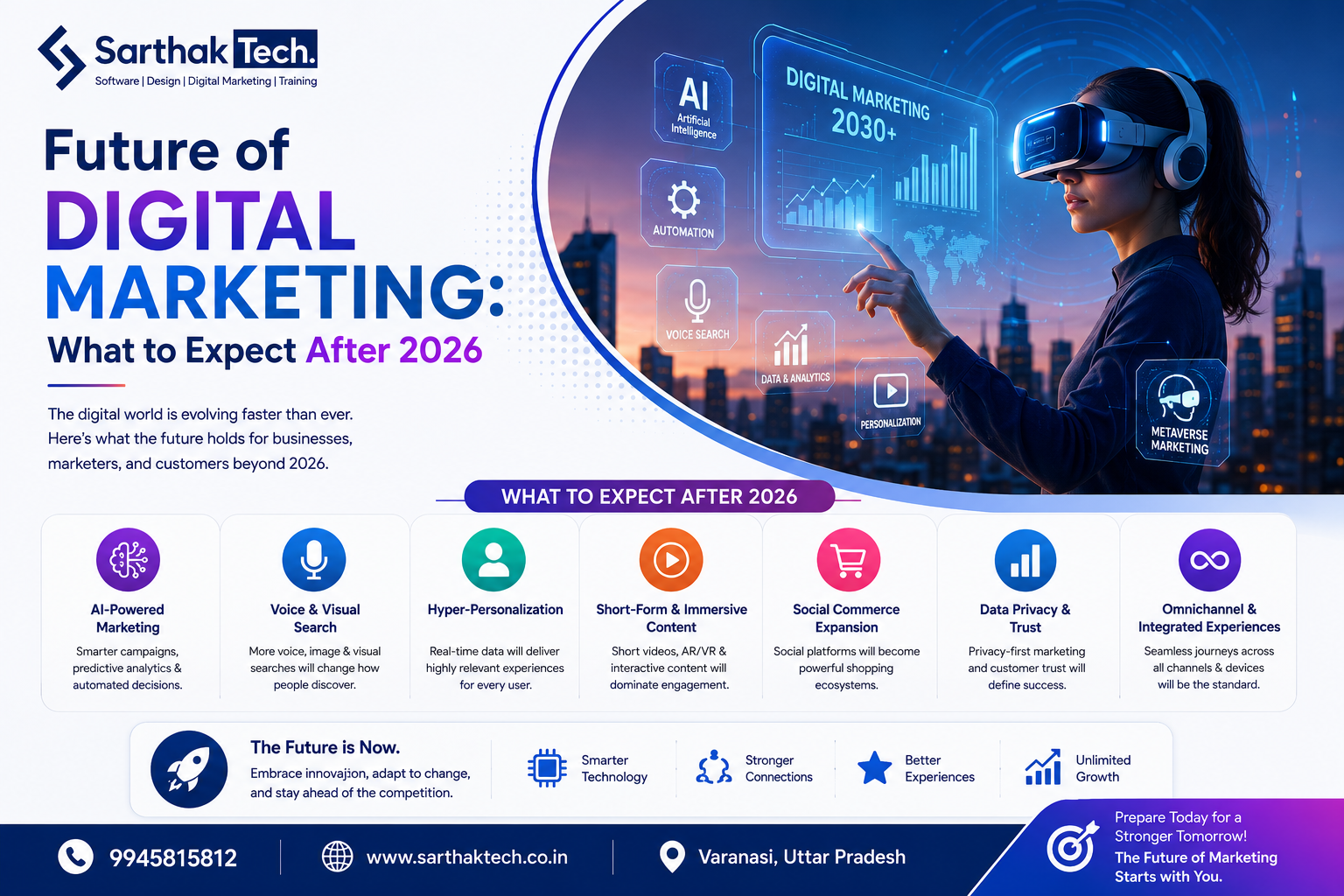
Digital marketing is evolving faster than ever. With advancements in artificial intelligence, automation, and changing consumer behavior, businesses must adapt to stay competitive. While SEO, social media, and content marketing remain essential, the future will be driven by smarter technologies and more personalized customer experiences.
In this article, we’ll explore the biggest digital marketing trends expected to shape the industry after 2026 and how businesses can prepare for the future.
Why Digital Marketing Will Continue to Grow
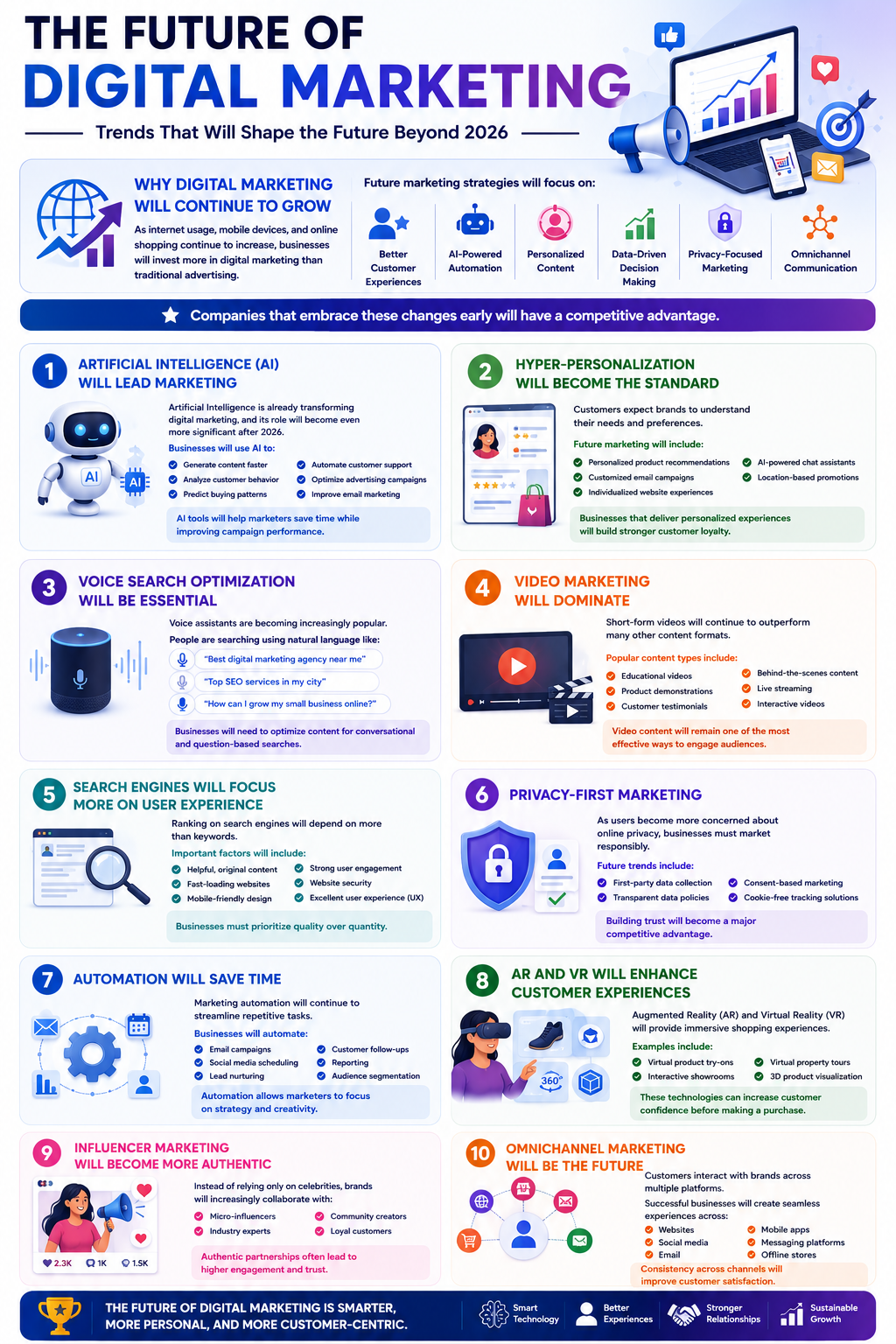
As internet usage, mobile devices, and online shopping continue to increase, businesses will invest more in digital marketing than traditional advertising.
Future marketing strategies will focus on:
- Better customer experiences
- AI-powered automation
- Personalized content
- Data-driven decision making
- Privacy-focused marketing
- Omnichannel communication
Companies that embrace these changes early will have a competitive advantage.
1. Artificial Intelligence (AI) Will Lead Marketing
Artificial Intelligence is already transforming digital marketing, and its role will become even more significant after 2026.
Businesses will use AI to:
- Generate content faster
- Analyze customer behavior
- Predict buying patterns
- Automate customer support
- Optimize advertising campaigns
- Improve email marketing
AI tools will help marketers save time while improving campaign performance.
2. Hyper-Personalization Will Become the Standard
Customers expect brands to understand their needs and preferences.
Future marketing will include:
- Personalized product recommendations
- Customized email campaigns
- Individualized website experiences
- AI-powered chat assistants
- Location-based promotions
Businesses that deliver personalized experiences will build stronger customer loyalty.
3. Voice Search Optimization Will Be Essential
Voice assistants are becoming increasingly popular.
People are searching using natural language like:
- “Best digital marketing agency near me”
- “Top SEO services in my city”
- “How can I grow my small business online?”
Businesses will need to optimize content for conversational and question-based searches.
4. Video Marketing Will Dominate
Short-form videos will continue to outperform many other content formats.
Popular content types include:
- Educational videos
- Product demonstrations
- Customer testimonials
- Behind-the-scenes content
- Live streaming
- Interactive videos
Video content will remain one of the most effective ways to engage audiences.
5. Search Engines Will Focus More on User Experience
Ranking on search engines will depend on more than keywords.
Important factors will include:
- Helpful, original content
- Fast-loading websites
- Mobile-friendly design
- Strong user engagement
- Website security
- Excellent user experience (UX)
Businesses must prioritize quality over quantity.
6. Privacy-First Marketing
As users become more concerned about online privacy, businesses must market responsibly.
Future trends include:
- First-party data collection
- Transparent data policies
- Consent-based marketing
- Cookie-free tracking solutions
Building trust will become a major competitive advantage.
7. Automation Will Save Time
Marketing automation will continue to streamline repetitive tasks.
Businesses will automate:
- Email campaigns
- Social media scheduling
- Lead nurturing
- Customer follow-ups
- Reporting
- Audience segmentation
Automation allows marketers to focus on strategy and creativity.
8. AR and VR Will Enhance Customer Experiences
Augmented Reality (AR) and Virtual Reality (VR) will provide immersive shopping experiences.
Examples include:
- Virtual product try-ons
- Interactive showrooms
- Virtual property tours
- 3D product visualization
These technologies can increase customer confidence before making a purchase.
9. Influencer Marketing Will Become More Authentic
Instead of relying only on celebrities, brands will increasingly collaborate with:
- Micro-influencers
- Industry experts
- Community creators
- Loyal customers
Authentic partnerships often lead to higher engagement and trust.
10. Omnichannel Marketing Will Be the Future
Customers interact with brands across multiple platforms.
Successful businesses will create seamless experiences across:
- Websites
- Social media
- Mobile apps
- Messaging platforms
- Offline stores
Consistency across channels will improve customer satisfaction.
Skills Future Digital Marketers Should Learn
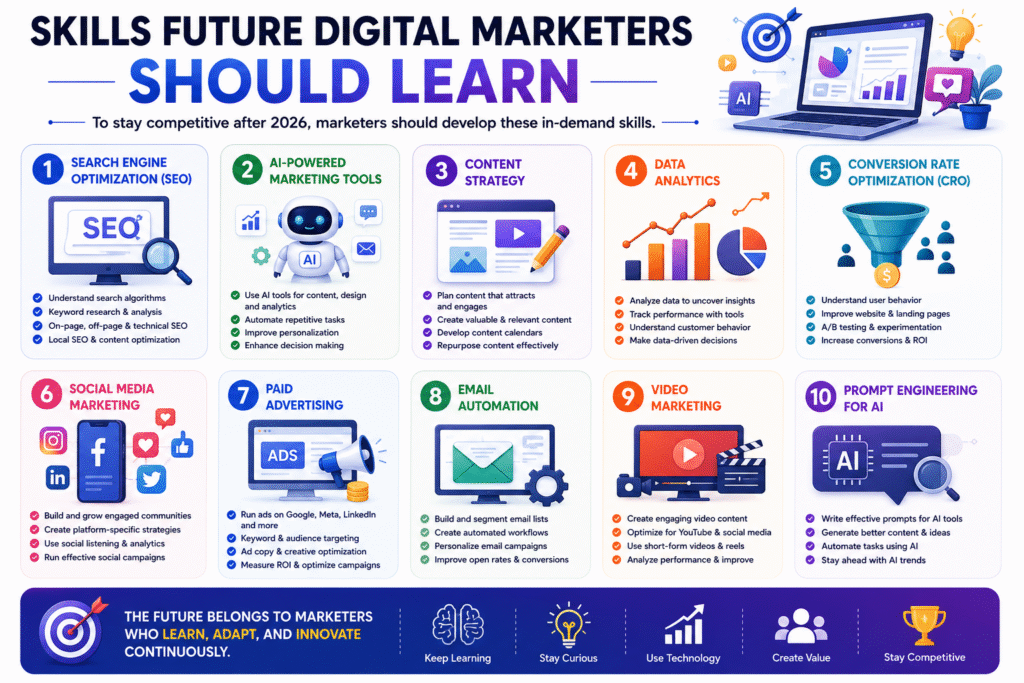
To stay competitive after 2026, marketers should develop skills in:
- Search Engine Optimization (SEO)
- AI-powered marketing tools
- Content strategy
- Data analytics
- Conversion Rate Optimization (CRO)
- Social media marketing
- Paid advertising
- Email automation
- Video marketing
- Prompt engineering for AI
Continuous learning will be essential as technology evolves.
How Businesses Can Prepare
Businesses should start preparing now by:
- Investing in high-quality content
- Adopting AI tools responsibly
- Improving website speed and user experience
- Building an email subscriber list
- Strengthening local SEO
- Creating more video content
- Monitoring analytics and customer behavior
- Prioritizing customer trust and privacy
Conclusion
The future of digital marketing after 2026 will be smarter, faster, and more customer-focused. AI, automation, personalization, privacy, and immersive technologies will reshape how brands connect with audiences. Businesses that embrace innovation while delivering genuine value will be better positioned for long-term success.
Digital marketing will continue to evolve, but one principle will remain constant: understanding your audience and providing meaningful experiences.
Frequently Asked Questions (FAQs)
The future will be driven by AI, automation, personalization, voice search, video content, privacy-first strategies, and immersive technologies like AR and VR.
No. AI will automate repetitive tasks, but human creativity, strategic thinking, storytelling, and relationship-building will remain essential.
Skills such as SEO, AI-assisted content creation, data analytics, video marketing, automation, and conversion optimization will be highly valuable.
Yes. SEO will remain a key channel, with a stronger emphasis on user intent, content quality, technical performance, and user experience.
Personalized experiences improve customer engagement, build trust, increase conversions, and encourage long-term loyalty.
Small businesses should focus on creating valuable content, optimizing for local SEO, using AI tools efficiently, investing in video marketing, building first-party customer data, and maintaining a mobile-friendly website.